
PLM Services
Your PLM system is the bookcase. We make sure it is filled the right way.
From product data to modular product lifecycle management
Structure first, then the system.
Product Data Management ensures that engineering data is structured, controlled and reliable. But reliable data alone does not create a scalable product portfolio.
MODULAR5 helps manufacturers establish a modular product architecture and translate it into reusable engineering structures, product configurations and PLM processes.
A new bookcase for your product data
Think of PLM as a new bookcase. Buying it is the easy part. The value comes from how it is filled: every book on the right shelf, so everything you need is easy to find.
MODULAR5 makes sure your PLM system is filled in a structured way: product architecture, modules, interfaces, bills of materials and configurations, properly embedded in your product data and processes.
Three layers, one result
We position our services in three layers. They depend on each other and do not have to be separated strictly, organizationally or technically.
PDM manages the product information. PLM manages the broader set of product information, processes and collaboration throughout the lifecycle, and PDM is often part of a PLM environment. Platforms such as PTC Windchill, Dassault Systèmes 3DEXPERIENCE, ARAS, PLM PRO.FILE and Contact PLM support both PDM functionality and broader PLM processes. The exact possibilities depend on the application, the roles and the design used.
A PLM system does not make you modular by itself
A company can have an excellently equipped PDM system and still re-engineer most customer orders. The data is manageable, but the product architecture is not necessarily modular.
PLM does not automatically enable modularization. That takes a deliberate product architecture. MODULAR5 develops the right modular architecture and helps translate it into the engineering structure and the PLM processes.
Example: an industrial machinery manufacturer with ten customer variants
| Subject | PLM approach with MODULAR5 |
|---|---|
| Components | Standardize parts and encourage reuse |
| Product structure | Design and manage a modular product structure |
| Variants | Build variants from standardized modules |
| Changes | Control the impact of changes on modules, variants and processes |
| Engineering | Reduce repetitive work through a modular architecture and reusable engineering |
| New customer order | Configure from existing modules where possible |
Global consistency, local agility
Tariffs, supply chain risks and the need for local sourcing force manufacturers to balance global design control with local production flexibility. The question is how one design can be built at several sites while engineering stays in control.
With PLM and modular design you define each module once, with its own E-BOM and configuration rules. The E-BOM describes what a module is. Multiple M-BOMs describe how each site builds it, all behind the same interface.
- Modules stay interchangeable across plants.
- Local sourcing does not require a redesign.
- Changes flow through one controlled structure.
- Traceability and configuration control are kept across global structures.
PLM provides the structure, modular design provides the flexibility. Together: global control with local freedom.
What PLM brings you
- One single source of truth: one source you can use with confidence to create and maintain products.
- Standardization and reuse: standard parts, modules and systems can be used and maintained.
- Collaboration: working together on the product in one place, from sales to service.
- Integration: integrated systems with data integrity, and easy access for co-engineering.
- Products and services: the latest product configuration is known across the lifecycle, so you can support your client.
The PLM Maturity Scan
Where do you stand today, and where do you want to be? The PLM Maturity Scan maps the current and the desired state of your PLM core capabilities, from part and BOM management, change and configuration management to requirements, quality, project and portfolio management.
- Desk research of your current situation and earlier studies.
- Interviews and workshops with the people involved.
- Where relevant, an assessment of PLM platforms against the same capabilities.
- Processing the results in our Capability Maturity Assessment (CMA) model: current state against desired state.
- A final presentation of the findings, with a first phasing for implementation.
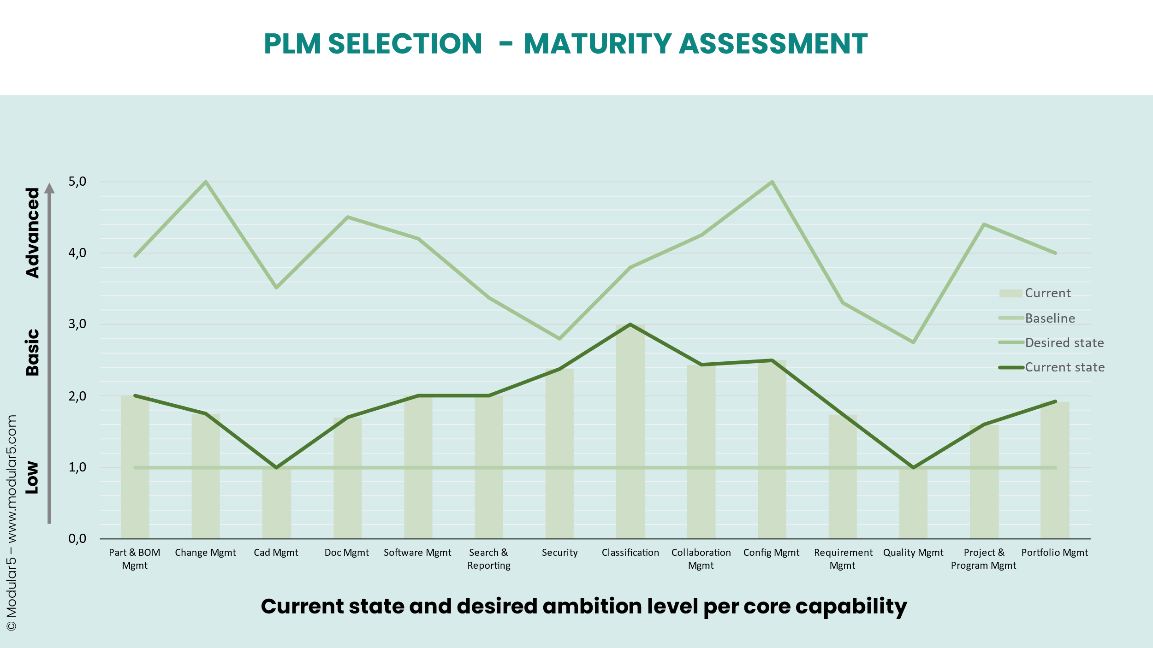
Example of the result: the current state and the desired ambition level per core capability.
Next to our engineering
PLM Services sit next to our Engineering. CAD modeling, drawing creation, BOM enrichment, article classification and building product structures provide the concrete data and structures that make a modular architecture work. Consultancy and engineering work side by side.
Not sure where to start?
Start with the PLM Maturity Scan, or tell us which system you use and how your engineering data is organized today. We will tell you where we can help.
Let's talk about your PLM landscape
MODULAR5 combines product strategy, modular architecture and engineering implementation to help organizations move from complex, engineered products to scalable, configurable product platforms.